Hammered or Cast: Two Ways to Give Gold a Form
Hammered or cast gold reflects different forming choices. Learn how walls, rims, joins, and ornament reveal how an object was assembled and shaped.
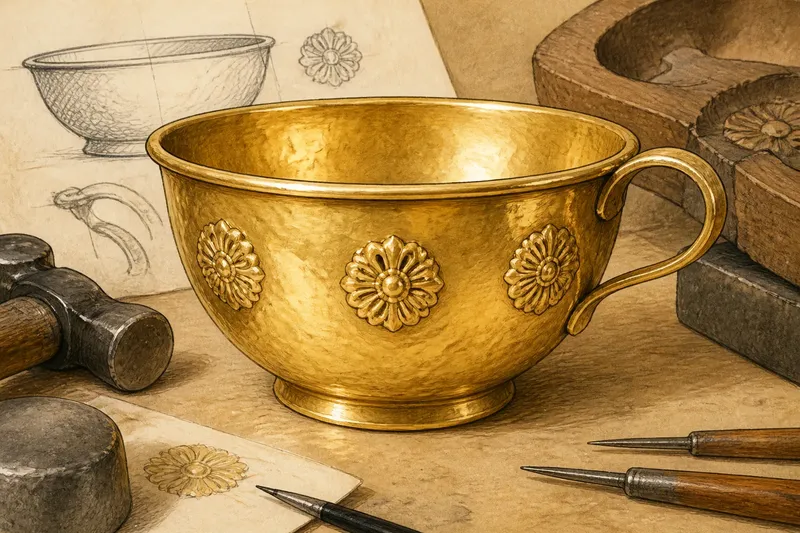
The most common mistake when comparing hammered or cast gold is treating one surface mark as a verdict. That shortcut can turn a description of construction into an unsupported claim about the whole object. Start instead with how its parts meet: the body, rim, base, handle, and ornament each may have taken shape by a different method.
Hammered and cast gold solve different forming problems
Hammering moves solid metal into a new shape. A maker works a piece of gold over a support or form, adjusting its curves and thickness as the material spreads. On a vessel made this way, the body may be continuous from base to wall, with the rim shaped from the same piece.
Casting forms metal inside a mold. The mold establishes a shape or pattern, and finishing can refine the result afterward. A cast component may be solid or hollow, and a larger object may combine it with separately made parts.
These methods are not mutually exclusive. A cast ornament can be attached to a hammered body, or a cast blank can receive further shaping. The clearest description identifies the method that seems relevant to each part, rather than assigning one label to the entire object.
Read construction before interpreting surface marks
Look at the object’s silhouette and the way its components connect. A vessel with a continuous body and a rim formed from its edge has a different construction from one assembled from a separate base, body, and decorative band. That distinction can be more informative than whether the surface appears smooth or irregular.
Check the inside and underside where you can do so without handling the object roughly. Note whether a handle meets the body at a clear boundary, whether an ornament sits above the surrounding surface, and whether an edge is rolled, folded, or joined. A visible boundary tells you that parts meet; it does not by itself reveal when or how they were made.
Think of construction like a paper package: a folded edge and an attached tab explain how parts relate, but neither detail alone tells you every stage of its making. On gold, use joins and transitions to frame questions about forming, not to leap to a complete account.
Hammered forms often carry the shape of worked metal
Hammering can create gentle shifts in curvature, shallow facets, or a surface that changes subtly as it catches the light. On a bowl, the wall may rise from the base in a continuous curve, while the rim is turned or thickened. These features can fit worked metal, but wear and later finishing may soften them.
Repeated facets may vary in direction or size as the maker adjusts the form. Yet ornament can imitate that pattern, and polishing can remove visible traces of working. Treat a mark as meaningful only in relation to the shape around it.
Cast parts can preserve mold-shaped design
A mold can produce repeated relief, recessed details, or consistent contours across matching elements. Depending on how the mold was made and finished, a line may remain where its sections met. Fine finishing can reduce or remove such traces, so their absence does not settle the question.
Look at the underside, inside, and junctions between components for small projections, trimmed areas, or seams. A projection might relate to how metal entered a mold, but it could also reflect assembly or repair. Describe its location and form before proposing an explanation.
Use observations to choose careful language
- Observation: The vessel body appears continuous into its base. If no separate boundary is visible, then describe it as a continuous form; otherwise note the boundary and leave open whether the parts were joined during making or repair.
- Observation: The rim turns outward from the wall. If it appears to continue from the same sheet, then describe a turned or worked rim; otherwise record a distinct join and avoid assigning a forming method.
- Observation: Several raised motifs look alike. If their outlines and small details closely repeat, then say they may have been mold-formed; otherwise describe them as similar ornament without inferring a mold.
- Observation: A line crosses a component boundary. If it follows a plausible meeting edge, then record it as a possible seam; otherwise describe it as a surface line whose cause is unclear.
- Observation: A handle meets the body at a distinct edge. If the boundary is clear, then describe the handle as separately attached; otherwise say only that the junction is visible or obscured.
- Observation: Facets or dents appear on a curved area. If they follow the changing contour, then note that they are consistent with working; otherwise record them as surface variation that may reflect wear, finishing, or another cause.
Say you are describing a small gold-colored bowl with a continuous-looking body, an outward-turned rim, three similar raised motifs, and a handle with a visible boundary. First, record the body and rim as a form that appears worked from a continuous piece. Next, note that the motifs repeat and may be mold-formed, without claiming that they are. Then describe the handle as separately attached, while leaving its forming method unknown. The resulting account distinguishes what is visible from what remains uncertain.
What do readers ask about hammered or cast gold?
Does a smooth gold surface mean the object was cast?
No. Polishing can smooth a hammered surface, and a cast surface can retain texture or receive additional finishing. Compare the object’s construction and component joins instead of using smoothness as a verdict.
Can a gold object be both hammered and cast?
Yes. A maker can combine a worked body with cast ornament, or cast a component and refine it afterward. Describe the parts separately when their construction appears different.
Can a photograph identify the forming method?
A photograph may show the overall shape, repeated motifs, or an obvious boundary, but it can hide the inside, underside, and subtle transitions. Use it to make a provisional description, not to claim a method that the image cannot establish.
What should I call an object when its method is unclear?
State the visible features: for example, “a curved body with a turned rim and a distinct handle junction.” This phrasing gives a useful description without presenting an interpretation as fact.
Record the parts and their relationships
Write down the object’s shape, how its edges are finished, where components meet, and whether repeated details are alike or varied. Note which areas you could not see and whether wear, a mount, or damage obscures a junction. Avoid scraping, polishing, bending, or applying chemicals to investigate a surface.
For hammered or cast gold, a sound account begins with the relationship between each part and the whole. If an object matters for its history, value, or condition, ask a qualified conservator or specialist to assess it in person. Their examination can address questions that a visual description alone should leave open.