Why Gold Appears in Medieval Manuscript Pages
Why gold appears in medieval manuscript pages: learn how devotion, patronage, material value, and workshop methods shaped illuminated books and their meaning.
The common mistake is to treat gold in a medieval manuscript as mere sparkle; that misses why patrons and makers paid to put it there. Why gold appears in medieval manuscript pages depends on a combination of religious purpose, visible wealth, and the craft methods that made precious surfaces part of a book’s design.
Gold made sacred subjects visibly distinct
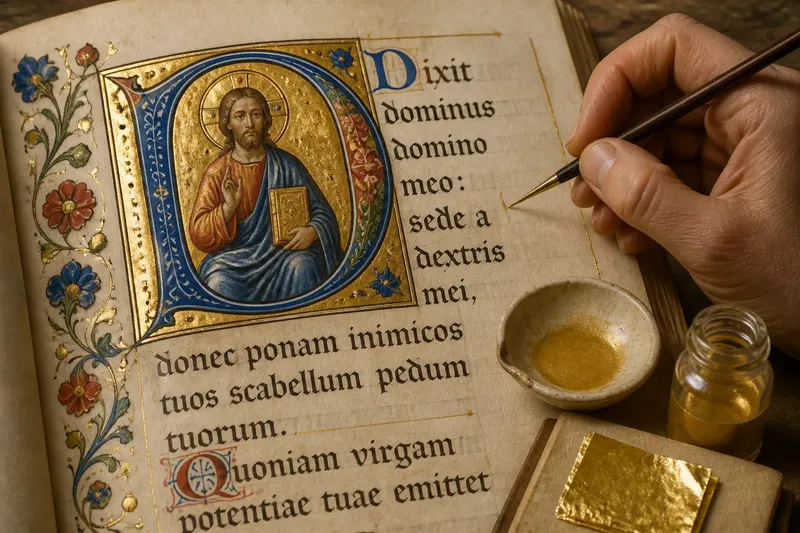
In many medieval Christian books, gold helped distinguish holy figures and scenes from ordinary surroundings. A gold ground or halo could mark a sacred presence, while gilded letters could signal the start of a prayer, Gospel passage, or important section. These choices belonged to a visual language shaped by the book’s religious use, not by one universal code.
Gold also suited images meant to suggest radiance that ordinary pigment could not imitate. Its reflected light gave a page a changing surface, unlike painted color, which generally appeared more uniform as the viewer shifted position. The effect could make a sacred image feel set apart without requiring a naturalistic setting.
Patronage and expense shaped the choice
Gold was a costly material, and its presence could signal that a manuscript had been made with substantial resources. A wealthy patron, monastery, or church might commission a lavish book for worship, display, or the preservation of important texts. Gold therefore carried material value as well as devotional associations.
Not every manuscript used gold, and not every gilded area had the same significance. The amount and placement depended on the commission, the book’s purpose, available materials, and the decisions of its makers. A restrained initial and a fully gilded image belong to different levels of investment and visual emphasis.
Medieval workshops applied gold with care
Illuminators used more than one method to add gold. They could apply thin gold leaf to a prepared surface or use powdered gold mixed with a binding medium as paint. The process depended on the desired finish and the workshop’s materials and skill.
Gold leaf required a carefully prepared ground so it would adhere and could be burnished to a smoother shine. Gold paint offered another way to add gilded lines or details, though its surface and reflectivity could differ from leaf. These are not interchangeable effects: the choice shaped how the finished page caught light.
Imagine a monastery commissioning a Gospel book with limited materials for decoration. The workshop chooses gold leaf for the opening initials and gold paint for fine lines around a figure; the visible result is a strongly marked beginning paired with lighter gilded detail. That distinction describes a plausible design decision, not evidence about any particular surviving manuscript.
Gold worked alongside text, pigments, and images
Gold’s meaning depended on its setting. Beside deep blue, red, or dark ink, it could stand out sharply; within a pale painted field, its effect might be subtler. A gold initial could announce a passage, while a halo or background could distinguish a figure inside an illustration.
Rather than assume every gold mark carries the same message, identify its role on the page. Ask whether it marks a sacred person, emphasizes a passage, frames an image, or contributes to the book’s display. The text, image, and manuscript’s intended use help narrow the interpretation.
How should you interpret gold on a manuscript page?
Does gold always mean that a passage is sacred?
No. Gold often appears in religious manuscripts and can emphasize sacred material, but it can also signal expense, status, or visual distinction. Interpret it alongside the text, image, and placement rather than assigning one fixed meaning.
What is the difference between gold leaf and gold paint?
Gold leaf is a thin sheet applied to a prepared surface, while gold paint uses powdered gold mixed with a medium. Leaf can create a smooth reflective area; painted gold is often suited to lines and smaller details.
Why does gold look different in a photograph?
Gold reflects light, so its appearance changes with illumination and viewing angle. A photograph can record its position and outline but may flatten the reflection or alter its apparent brightness.
Can gold identify a manuscript’s exact date or maker?
Gold by itself cannot establish an exact date or identify an individual illuminator. Historians assess it with other evidence, such as script, materials, style, provenance, and the manuscript’s contents.
Record observations without overstating them
Use a short set of notes to separate what you can see from what you infer. For each item, make the stated decision only if the observation supports it:
- Observe whether gold appears in an initial; if it begins a passage, describe it as a visual marker, but if it does not, note its actual location instead.
- Observe whether gold forms a halo or surrounds a figure; if so, consider a sacred distinction, but if not, avoid assigning that role.
- Observe whether the gold is a broad reflective patch or fine painted lines; if the surface is clear, note the likely difference between leaf and paint, but if not, mark the technique as uncertain.
- Observe which pigments or ink sit beside the gold; if contrast is strong, describe the visual separation, but if it is subdued, describe the gold as integrated with its surroundings.
- Observe whether the text identifies a prayer, Gospel passage, or other subject; if it does, use that context when interpreting the gold, but if it does not, keep the interpretation limited to the page’s visible design.
- Observe whether you are viewing the original or a digital reproduction; if it is a reproduction, use it to assess placement, but if you need to judge reflection or surface texture, consult an authorized in-person view or a qualified manuscript specialist.
These distinctions make the question of why gold appears in medieval manuscript pages easier to answer without reducing every gilded mark to a symbol. Gold could express devotion, display a patron’s resources, distinguish a passage, or unite image and text; the page’s material and historical context determines which explanation fits best.