How to Read Gold Details During a Gallery Visit
Use a gold-detail gallery exercise to describe surface, placement, and context clearly, while separating visible evidence from assumptions about material or meaning.

The common mistake in a gold-detail gallery exercise is to name a symbol before checking what the object actually shows. That can turn a border into a claim about holiness or wealth without enough evidence. Start instead with the gold’s material appearance, construction, and relation to the object’s use.
Choose one object with a visible gold-colored feature, such as a clasp, rim, painted accent, or gilded frame. Work through the observations in order; if the detail is blocked by a reflection or a crowd, select another object rather than forcing a reading.
1. Choose a gold feature you can inspect clearly
Pick a specific feature, not “all the gold.” A narrow strip on a vessel, a clasp on a box, or a repeated accent in a painted scene gives you a defined area to examine.
Stand at an ordinary viewing position where you can see both the feature and the surrounding material. If the case or lighting obscures its edges, move to an allowed viewing spot; if it remains hard to see, choose a clearer object.
2. Describe the surface without naming its material
Note the visible color, sheen, texture, and edge. You might describe a feature as “a muted gold-colored strip with a smooth surface” or “a bright, uneven patch beside dark paint.” Those descriptions remain useful even when the material is uncertain.
Do not assume that a gold-colored surface is solid gold or leaf. It could be paint, metal, gilding, or another finish, and sight alone may not settle the question. If the distinction matters, consult the object label or collection information.
3. Inspect how the gold was made part of the object
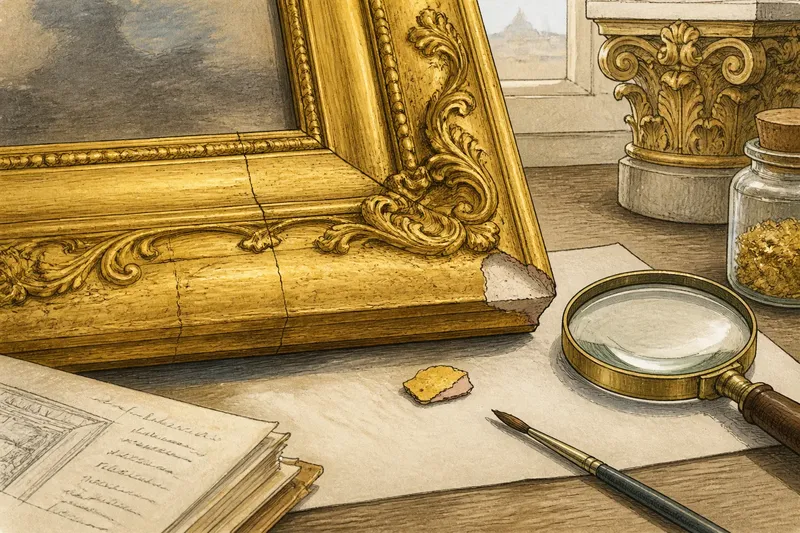
Look for visible clues about form and construction. Is the gold-colored area painted onto a surface, set into a border, wrapped around an edge, or attached as a separate fitting? Describe only what you can see; a seam or raised edge may suggest a separate element but does not identify its material by itself.
Consider whether the feature follows the object’s shape or interrupts it. A band that follows a rim may reinforce the outline, while an attached clasp may connect decoration with opening and closing. Treat these as descriptions of the object’s visible arrangement, not claims about the maker’s intent.
4. Relate the feature to the object’s use and form
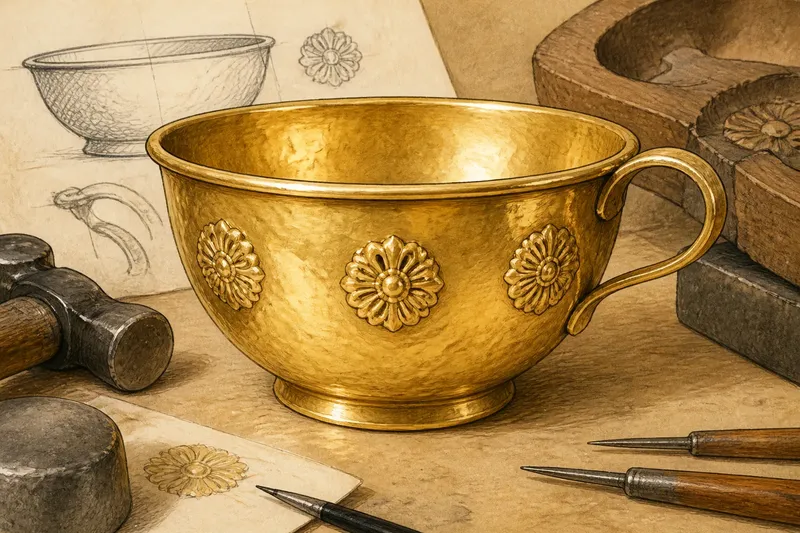
Identify what kind of object you are looking at and which parts appear functional. On a vessel, compare the gold-colored detail with the rim, handle, and body; on a box, compare it with the lid, hinge, and clasp. This makes it easier to distinguish a decorative feature from a working fitting, while allowing that one element can serve both roles.
Imagine you choose a wooden box with a gold-colored band around its opening and a small clasp at the front. You see that the band follows the rim, while the clasp sits where the lid meets the body; your notes can describe the band as outlining the opening and the clasp as marking the closure, without claiming either is made of gold or assigning a symbolic meaning.
5. Compare the gold with nearby materials
Check what touches or surrounds the feature: dark paint, pale stone, wood, fabric, glass, or another metal. Record whether the gold-colored surface stands apart, blends in, or repeats a nearby color or shape. Like a bright label on a plain box, a contrasting detail can be easy to notice because of its surroundings as much as its own appearance.
Look for repeated forms. If similar gold accents appear elsewhere, compare their shape and placement; if one differs, describe the difference rather than immediately calling it more important. This comparison helps distinguish a repeated design element from an isolated one.
6. Check the object’s label and cultural context
After making visual notes, read the museum label or collection entry for information about material, date, place, maker, or original use. Keep the source of each point clear: “the label identifies the frame as gilded” is different from “the frame looks gold-colored.”
Meanings associated with gold vary across communities, periods, and objects. A gold detail may carry religious, political, ceremonial, decorative, or practical significance, but color alone cannot establish which interpretation applies. Use the object’s subject and documented context to assess a possible meaning.
7. Record observations and interpretations separately
Write down three observations: what the surface looks like, where it sits, and how it relates to the object’s construction or use. Add a separate note for any interpretation, along with the evidence or label information that supports it.
- If the surface is bright and reflective, note that appearance; if glare hides its texture, change your viewing angle or choose a clearer feature.
- If the edge appears raised or separate, describe the visible boundary; if you cannot distinguish it from the ground, record it as a surface detail instead.
- If the feature follows a rim, handle, or joint, note that relationship; if its location is unclear, describe its position without assigning a function.
- If similar marks repeat, record their shared shape or spacing; if one mark differs, note the variation rather than treating it as a symbol by itself.
- If the label names a material or technique, attribute that information to the label; if it does not, use “gold-colored” in your notes.
- If a proposed meaning is supported by the object’s subject or documented context, mark it as an interpretation; if not, keep the note to visible form and placement.
What questions help distinguish appearance, making, and meaning?
How can I tell whether a gold surface is real gold?
You generally cannot identify its material with confidence by sight alone. Describe its color and finish, then consult the museum label or collection information if the material matters.
Does a gold border always have a symbolic meaning?
No. It may serve a decorative or structural role, or carry a meaning tied to a particular object and tradition. Look for contextual evidence before making a symbolic claim.
What should I write if I am unsure how the detail was made?
Use a description tied to what is visible, such as “a gold-colored band around the rim.” If the surface seems raised or attached but you cannot tell how, note that uncertainty rather than naming a technique.
When should I read the museum label?
Make a brief visual description first so you can separate what you saw from what the label says. Then use the label to check material, date, use, or context that cannot be established by looking alone.
8. Keep the final account specific and open
Combine the notes without turning an inference into a fact. For instance: “A gold-colored strip follows the vessel’s rim and contrasts with the darker body; the label identifies the finish as gilding.” If the label gives no material information, leave that part unresolved.
A focused gold-detail gallery exercise is most useful when it records how a feature was made, where it belongs on the object, and what the available context supports. The same careful description can help you compare objects later without treating every gold surface as if it carried the same purpose or meaning.