The Midas Touch Is Not a Complete Reading of Gold
The Midas touch can make gold seem like a shorthand for greed. Read an object’s use, form, and materials to build a more precise interpretation.
The most common mistake in reading gold is to see a gold surface, assume greed, and stop there. That shortcut can obscure other meanings, from devotion and authority to mourning, welcome, or skilled labor. The Midas touch is one useful interpretation of gold, not a verdict on every gold object.
Use this seven-part exercise over a week, completing one stage per day, or work through the stages in one sitting if you have time. Each stage asks you to examine a different feature of the object and build an interpretation from what you can actually observe.
Start with the Midas association, then set it aside
Choose a gold-colored or gold-covered object in a museum, place of worship, shop window, or home. Write down your first reaction in plain words: “showy,” “sacred,” “expensive,” “warm,” or “old.” Treat this as a record of your instinct, not a finished interpretation.
Ask what prompted the Midas association. Is gold abundant? Does it appear on a coin, crown, trophy, or luxury package? Or did the color alone call the story to mind? An object can invoke wealth without celebrating greed, and gold can appear without making wealth its subject.
Describe the gold’s form and construction
Look at the object’s structure rather than treating its surface as the whole message. Gold may form the object, cover another material, appear as a small accent, or sit among glass, wood, stone, paper, or fabric. Note whether it traces an edge, fills a field, or draws attention to a central image.
Do not assume that a gold appearance reveals the material or technique beneath it. If there is a label, use its wording as a starting point; otherwise, describe what you see and leave the construction open. Follow an institution’s directions about handling or conservation rather than touching or testing the surface.
Read the object’s purpose before assigning a meaning
Ask whether the object is meant to be worn, held, displayed, exchanged, or visited. A medal worn on a uniform has a different role from one kept in a case, even if the object itself is unchanged. If it belongs to a ritual or routine, note how that practice directs attention toward it.
Check any label or account from a custodian, and keep that information distinct from your own observations. A label may explain a specific use; the object’s present appearance and arrangement show how that use is presented to viewers now.
Notice the people and practices connected to the object
Rather than treating the surroundings as a code that settles the meaning, ask who made, uses, maintains, or encounters the object. A ceremonial object may serve a community, while a modest gold accent may hold private significance. Consider whose account of the object is available and whose perspective may be missing.
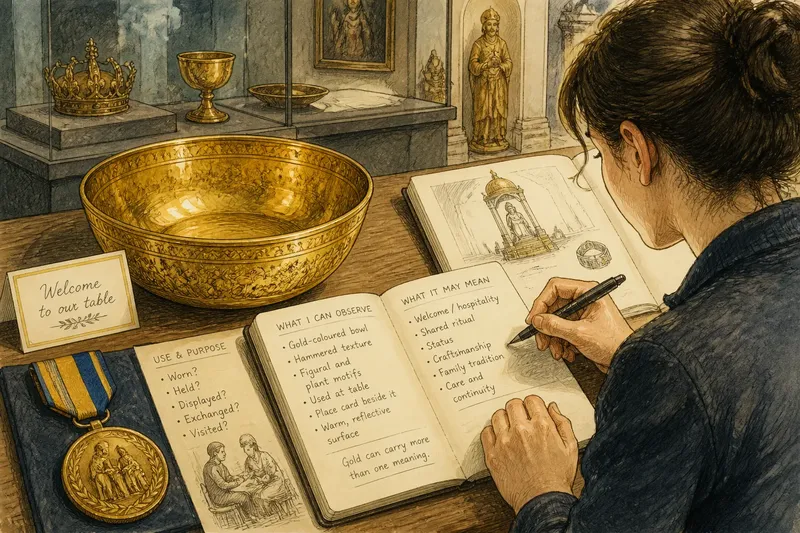
Imagine a gold-colored bowl on a family table beside a handwritten place card. The bowl’s color might suggest status, but its use at a shared gathering could also make it a sign of welcome. The interpretation depends on the role people give it, not just the color or display.
Keep competing meanings in view
Make two columns in your notes: “What I can observe” and “What it may mean.” In the first, write details such as “gold border around a figure” or “medal worn on a uniform.” In the second, consider possibilities such as honor, sacred presence, remembrance, wealth, or invitation, linking each reading to a detail or known use.
Gold can carry opposing meanings at once: abundance and restraint, authority and care, or permanence and fragility. Think of a frame around a photograph: it directs attention, but it does not tell you who is pictured or what the moment means. Gold can likewise shape how an object is seen without supplying its full message.
Revise the first impression with a specific detail
Return to your opening note and ask what it left out. Did “greed” overlook the object’s purpose, the people who use it, or the work of making and caring for it? If the object does concentrate wealth or present authority as unquestionable, say so precisely and identify what supports that reading.
Say you encounter a gold-colored medal above a community noticeboard. You first write “status symbol.” Then you notice that its inscription names a shared act of service and that it hangs among local announcements. You revise your reading to “public honor tied to community memory,” while noting that the display may also reinforce hierarchy. This is an invented situation, not a claim about a real object.
Write a reading that separates observation from inference
Bring your notes together in a short paragraph. Name the object and its purpose, describe one or two visible details, then offer a reading that accounts for more than wealth alone. Use measured phrasing such as “may suggest” or “functions here as,” and state what you cannot tell from the evidence available.
For example: “The gold border draws attention to the central figure, and the object’s use in a public ceremony gives that image a shared role. It may signal honor or sacred importance; these details do not establish whether every viewer understood it the same way.”
Questions readers ask about the Midas touch and gold?
Why is gold associated with greed?
The Midas story links a desire for wealth with destructive consequences: everything the king touches turns to gold. That association remains useful, but it does not explain every object made with or colored like gold.
Does gold always symbolize wealth?
No. Gold may suggest honor, sacred presence, remembrance, welcome, or authority, depending on its purpose and use. Describe what the object does before deciding which meanings fit.
How can I interpret gold in an artwork or designed object?
Identify where gold appears, what it emphasizes, and how the object is used. Then connect those observations to a possible meaning and name what the available context cannot establish.
Can gold suggest more than one thing at once?
Yes. An object may communicate prestige while serving a shared ritual, or suggest permanence while showing visible fragility. If the details support mixed meanings, let the interpretation hold that tension.
When you next notice gold, keep the Midas touch in view but not in command. Begin with the object’s purpose, form, and use, then test your first impression against those details. That makes the familiar gold-as-greed reading more precise without pretending that one interpretation fits every object.