Leaf, Gilt and Gold: What the Surface Can Tell You
Gold surface treatments can look alike. Learn how to describe visible seams, wear, and finish without claiming a material the evidence cannot confirm.
The common mistake with gold surface treatments is to name the material from its shine alone. That can lead you to call a brass-colored coating gold or mistake thin gold leaf for solid metal; careful observation helps you describe what the surface shows without overstating what it proves.
Separate appearance from construction
Gold names a metal, while “gilt” describes a surface made to look gold through an applied finish. “Gold-colored” is broader still: the color may come from gold, another metal, pigment, or a reflective film. These terms answer different questions, so keep them distinct when describing an object.
Inspect the surface in bright, indirect light, using a magnifier if one is available. Look across broad areas and edges without scraping, rubbing, or polishing. A surface may offer clues to its construction, but color and sheen cannot establish its ingredients.
- Gold leaf: A very thin sheet of gold applied to a prepared surface, often with an adhesive or binder. If you see fine joins or overlaps, describe them as visible seams; if you cannot see them, do not rule out leaf.
- Gilding: A broad term for a gold-like applied finish that may use leaf, powder, or another method. If a record identifies the method, name it; if not, describe the visible finish without specifying its material.
- Gold plating: A layer of gold deposited over a base material, commonly by an electrochemical process. If documentation confirms plating, use that term; if the only clue is a smooth, reflective surface, call it gold-colored instead.
- Gold-colored finish: A visual description that does not claim gold is present. If composition is unknown, this is the safer wording; if reliable documentation identifies the material, add that information and its source.
Read seams and wear as clues, not proof
Leaf is applied in sheets or smaller pieces, and the joins can appear as fine lines, slight overlaps, or irregular boundaries. On a carved frame, seams may follow raised details; on a flat panel, they may form a patchwork that becomes clearer at an angle. These patterns can suggest an applied sheet, but they do not confirm the material by themselves.
Other clues include an uneven reflection and small changes in texture. Older finishes may show wear on projecting corners, where a gold-colored layer has thinned or a differently colored ground is visible. A dark line might be a seam, crease, or feature in the underlying material, so do not label it damage without further evidence.
If the object matters, record visible details rather than trying to uncover a hidden layer. Note where the finish changes, whether an edge appears raised, and what color is visible in existing losses. Do not lift a loose fragment; a conservator can examine the layers while reducing the risk of further loss.
Compare leaf, plating, paint, and lacquer carefully
A smooth finish without visible sheet joins might be plating, paint, lacquer, or leaf applied with careful overlaps and later burnished. Plating can follow the contours of a small metal object, while paint or lacquer may bridge fine recesses or build up near an edge. Treat these as clues, not a visual test that can identify a process with certainty.
Gilding often serves as a general label for decorative gold-colored work on furniture, frames, and architectural details. When a description uses the word, ask whether it refers to appearance, a craft process, or a confirmed gold layer. A maker’s record or collection document can clarify the claim; sheen alone cannot.
Think of a surface description like a label on a storage box: it should tell the next person what is visible without pretending to show what is inside. Record observations first, then distinguish them from any interpretation.
Use cautious language when records are incomplete
“Solid gold,” “gold leaf,” and “gold plated” make claims about material or construction. A photograph can show color and texture, but generally cannot establish an alloy, base material, or layer composition. Treat a precise label cautiously when no object record or material documentation supports it.
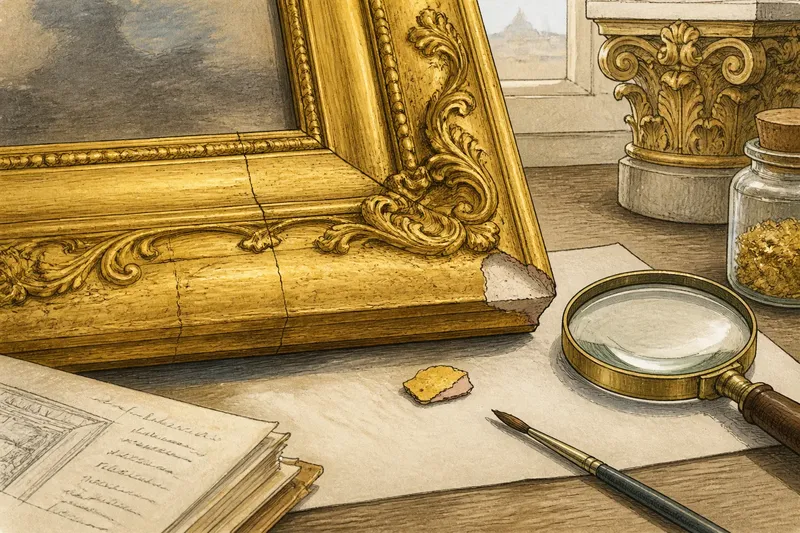
Say you are describing an imagined gilt frame with fine seams across its broad face and a pale base showing at a chipped corner. You note the seams and the visible ground, then write: “The frame appears to have an applied gold-colored leaf finish over a lighter ground; the materials have not been confirmed.” The result preserves the observations while making the uncertainty explicit.
For an object you own, check maker’s marks, original paperwork, or conservation records before naming a material. For a museum object, distinguish its catalog description from your own observations. If authenticity or value matters, consult a qualified appraiser or conservator rather than relying on appearance.
What questions help describe an unfamiliar surface?
Can color tell me whether a finish contains gold?
No. Gold alloys, varnishes, pigments, brass, and other finishes can look similar, and lighting changes how a surface appears. Describe the color as an observation; rely on documentation or suitable professional examination for a claim about composition.
Do visible seams prove that a surface is gold leaf?
No. Seams can be consistent with applied leaf, but other layered finishes can also show joins or patches. Record their shape and location as clues to construction, not proof of material.
Is gilding the same as gold plating?
No. Gilding is a broad term for a gold-like applied finish, often made with leaf, while plating refers to a deposited metal layer. If a description says only “gilt,” it does not identify a particular method.
What should I do if a finish is flaking?
Stop handling the affected area and avoid household polish, adhesives, or cleaning products. Leave loose pieces in place if possible, and ask a conservator how to care for a fragile decorative surface.
Choose words that match the evidence
Build a description from visible details, then state what remains uncertain. For example: “A reflective, gold-colored layer follows the raised carving; small seams are visible, and a pale ground appears at one worn edge.” If a reliable record identifies leaf or plating, cite that record rather than implying the surface itself proves it.
That distinction makes a description more useful to the next reader. “Gold” can name a material, “leaf” an applied sheet, and “gilt” a broader finish; for an unknown object, gold-colored is often the clearest starting point. With gold surface treatments, precise wording preserves both the visual detail and the limits of what observation can establish.